Brunswick, GA · Garage Door Service
Spring Repair for Dock Junction's 1979-Era Garage Doors
Dock Junction homes mostly date to 1979, which puts original torsion springs near the end of their cycle life. Brunswick Garage Door Pros covers spring repair here, 5 miles out.
- Repairs & new doors
- Springs & openers
- Serving 4 nearby communities
How Long You Are Without the Door
A broken spring doesn't mean a broken opener, but it does mean the door won't move safely either way, and that's the part people get wrong first. The opener will still hum and try, and that's exactly how a second part gets damaged trying to lift a door with no spring tension behind it. The right move is to leave the door down, unplug the opener if you can reach it, and wait for a tech rather than trying to force it up by hand.
Dock Junction sits about 5 miles from Brunswick, where the truck comes from. That's a short run, not a long one, but it's still a drive, not a walk-over, so the door stays parked until someone gets eyes on the spring and the cable drums beside it. On a lot of Dock Junction's 1979-built houses, that first look also turns up what's really going on: the spring on the door now isn't the spring the house was built with, because somebody already swapped it once, and sometimes not with the right size.
What the Fix Involves
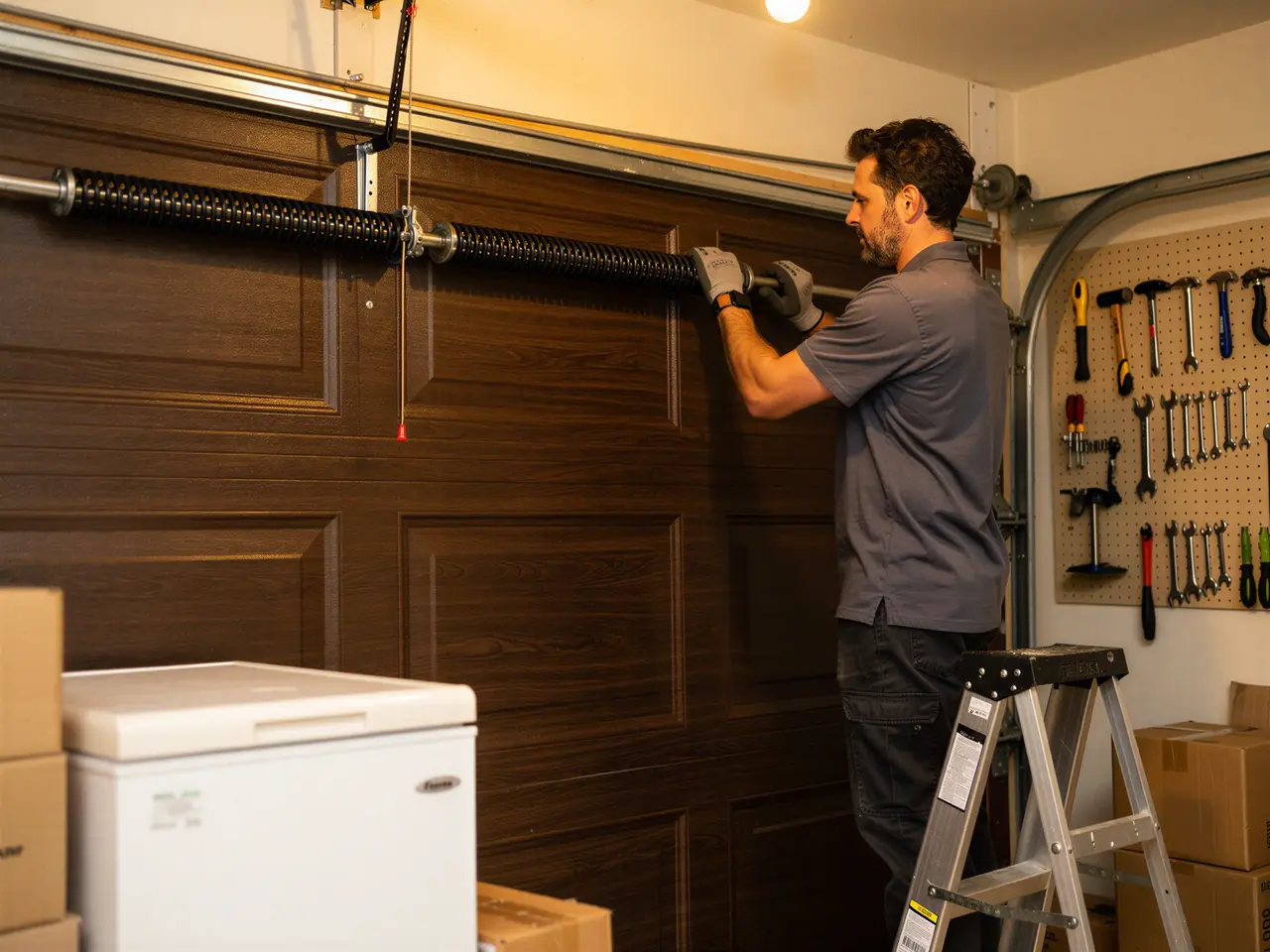
Torsion springs are rated in cycles, not years, and a cycle is one open-close. A door that's been opening twice a day since the house was framed in 1979 has put a lot of cycles on whatever spring sits up there now. The fix is a straight swap: measure the wire size, inside diameter, and length of the existing spring (or springs, most two-car doors run a pair), match it to the door's actual weight, and set the winding cones to the right number of turns. Cables, drums, and the center bearing plate get checked at the same time, because a spring rarely fails alone - a worn cable or a dry bearing usually took it there.
One limitation worth saying plainly: if the spring size on the door doesn't match what the door actually needs - which happens more than people expect on houses this age, after a prior repair or a DIY swap - the job isn't a five-minute part change. It means re-measuring the door from scratch, and that takes longer than a like-for-like replacement.
Why This Fails Locally
Most of the housing stock across this part of the service area went up between 1979 and 1987, and Dock Junction's own homes track right at the early end of that, median year built 1979. That matters for springs specifically: doors from that era were built to the standard torsion hardware of the day, and three to four decades of daily openings later, a lot of those springs are original, or close to it, and sitting right at or past the cycle count they were rated for.
The climate here is mild with only occasional freeze, which cuts both ways. It means Dock Junction doesn't see the hard freeze-thaw cycling that stiffens springs and snaps them cold in harsher climates further north - but it also means a failed spring here is almost always plain fatigue, metal that's simply done its job too many times, not a weather event. With 3,174 households in Dock Junction, and a median income of $48,600 - noticeably below the $56,746 median across the wider service area - a lot of homeowners here are choosing between a straight spring swap and a full torsion conversion, and the straight swap is usually the right call unless the hardware itself is failing too.
What Can Go Wrong
A spring that snaps clean is the easy case. What's harder is a spring that's partially failed - still holding some tension, still letting the door move, but unevenly, so one side of the door drops faster than the other and racks the track. Keep opening the door in that state and you can bend the track or crack a panel, turning a spring repair into a bigger bill.
On older torsion setups like a lot of what's still running in Dock Junction, the winding cones themselves can be worn or undersized for the door's actual weight, which is a separate issue from the spring wearing out - and it's one reason a tech checks the whole shaft assembly, not just the spring. Extension-spring doors (less common here than torsion, but still around on some of these 1979-era builds) carry their own risk if they were never fitted with containment cables, since a failed extension spring with no cable running through it can snap free under tension. Any of these is worth a look before the door gets used again, not after.
Frequently asked questions
How do I know if it's the spring and not the opener?
If the opener motor runs but the door won't lift, or only lifts a few inches and stalls, that's almost always the spring, not the motor. A door with a broken spring also feels extremely heavy if you try to lift it by hand - that weight is the giveaway. Don't keep running the opener against it; that's how a second part fails.
Are the springs on my Dock Junction house original?
Possibly, especially on houses built around 1979, which is the median age for homes in this area. A lot of original torsion springs from that era are well past the cycle count they were rated for. Some houses have already had one replacement, sometimes with hardware that doesn't quite match the door's actual weight.
Do you cover Dock Junction from a local branch?
The company runs out of Brunswick, about 5 miles away, and covers Dock Junction from there - there's no separate branch in Dock Junction itself. That distance is short enough that it doesn't add meaningfully to the job.
Is it cheaper to replace one spring or both?
On a two-spring torsion door, most techs replace both at once even if only one broke, since the second is usually close behind it in cycle life if the door was built with a matched pair. That's a judgment call based on the specific door's age and spring condition, not a fixed rule.
More garage door services in Dock Junction
Book garage door service in Brunswick
Call now or request a quote - tell us what the door is doing and where you are.